If you’ve been in the homeschooling world for more than five minutes, you’ve probably heard the phrase “unit studies” thrown around. But if the thought of building an entire custom curriculum from scratch feels overwhelming, or if you are stuck in a rigid textbook rut that is draining the joy out of your school days, I have some exciting news for you.
Today, we are breaking down exactly why unit studies are so powerful, how you can easily design your own, and some brand-new tools (both physical and free printables!) to help you do it.
1. The Magic of Unit Study Learning (Even as a Supplement!)
A unit study takes a single, fascinating topic and weaves multiple subjects like history, science, language arts, and art naturally around it.
The biggest benefit? Deep engagement. When children get to dive headfirst into a topic they actually care about, learning stops feeling like a chore. They aren’t just memorizing disjointed facts for a Friday test; they are making meaningful connections across subjects.
Pro-Tip: You don’t have to completely abandon your current curriculum to enjoy this! Unit studies make the perfect supplement. You can take a week-long break between textbook chapters to do a deep dive into a seasonal topic, or use a mini-unit study on Friday afternoons to add a splash of hands-on excitement to your routine.
2. How to Build Your Study: From Brainstorming to Reflection
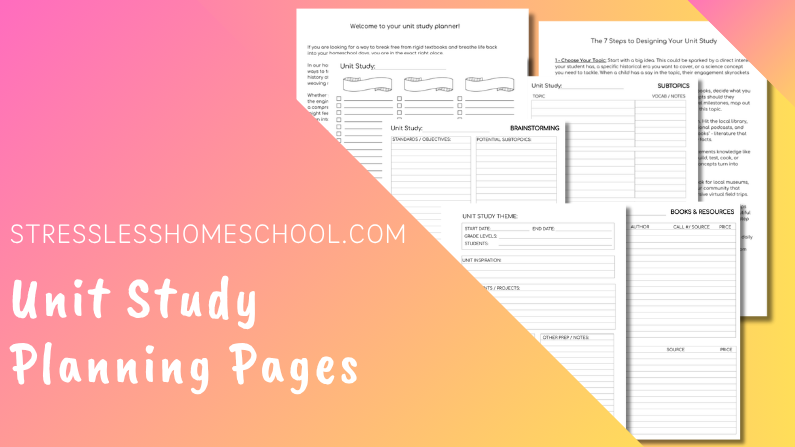
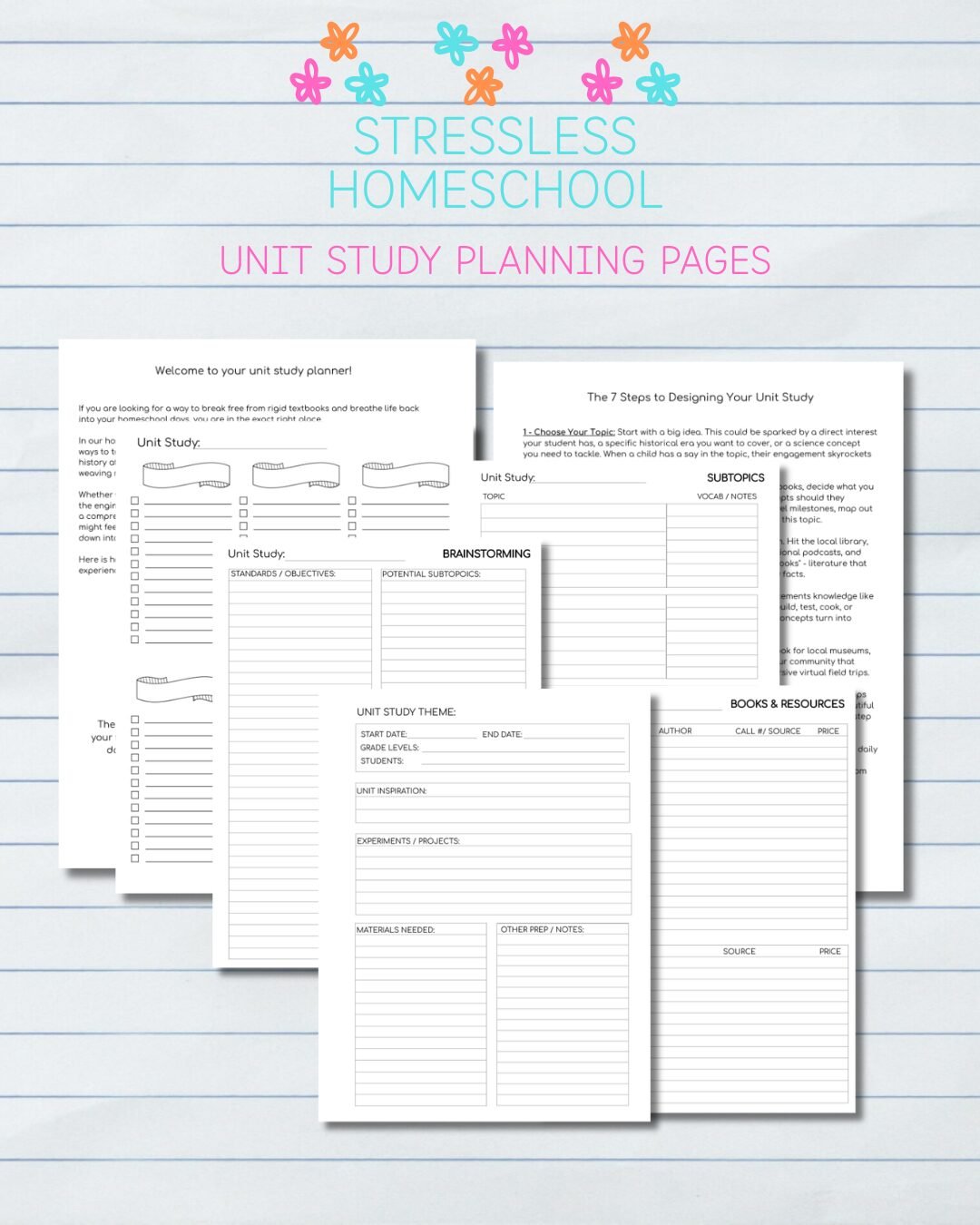
To make planning stress-free, I break the process down into a simple, structured workflow using a dedicated 8-page system. Here is a quick look at how to easily build your next unit:
Brainstorm & Target: Start by dumping all your big ideas onto paper. Once you have a theme, decide on your core learning objectives. What do you actually want your student to walk away with?
Source & Align: Gather library books, documentaries, podcasts, and games. If a book doesn’t serve a goal, save it for free reading! This keeps your study lean and purposeful.
Hands-on & Field Trips: Map out your tactile experiments, cooking projects, and local field trips. This is where abstract concepts turn into real-world understanding.
Daily Flow & Reflection: Lay your resources out into a flexible daily schedule. At the end of the unit, use the Review & Reflection page to log completed books, track achievements, and let your child note what they loved most.
3. Prefer a Bound Book? Find it on Amazon!
If you love the feeling of a physical notebook in your hands, I am thrilled to share that The Homeschool Unit Study Planner is officially published and available on Amazon!
This physical edition is perfect for parents who want a beautiful, durable archive of their school year. It features all of our brainstorming tools, the full how-to guide, and enough duplicated 8-page bundles to plan, track, and record 15 complete unit studies. When the year is over, it doubles as an official portfolio and a gorgeous keepsake of everything your family accomplished.
4. Print-Your-Own for Free (or Donation) via Ko-Fi!
I know that every homeschool budget looks different, and I want these tools to be accessible to absolutely everyone. If you prefer a loose-leaf system, want to plug pages into a 3-ring binder, or just want to try a single unit before committing to a full book, I’ve got you covered.
I have made a digital, printable version of the entire planning template pack available on my Ko-Fi page.
You can download it for free (just enter $0 at checkout), or choose to leave a small donation if you find the resource helpful. Your generous support helps me keep creating free tools, guides, and resources for our amazing community!
Students draw or write about how they have changed since 2020, what their life is like now, and what they expect for to happen by 2024. Simple worksheet that can be adapted to various ages, skills, etc.
What advice would you give to yourself four years ago? What do you hope your life is like four years from now? Write a letter to your past or future self.
Eight common idioms that use the word “leap” in a figurative way. Space for students to write what the idiom means and draw or write what the literal phrase sounds like.
For us, especially in the pre-school and elementary ages, homeschooling looked a lot like kids just go everywhere mom goes. These little sponges pick up so much, incorporating lessons and practice into everyday tasks. We even created a catchphrase, singing “Everyday Math!”, any time we had to figure some real life math problem.
Bringing kids along everywhere has some challenges though. The number one difficulty for us – waiting. Whether standing in line or long rides in the car, bored kids quickly turn into grumpy kids. Our solution was playing games whenever the need arose. Looking back, quite a few of our silly games laid important foundations in math, language and thinking ability.
#1 – The Alliteration Game
Take turns adding words to a sentence, each beginning with the same letter or sound. Sentences don’t have to be true but should be grammatically correct. Words can be added at any point in the sentence. Small words (articles, prepositions) don’t have to be alliterative. Example:
Keep going until you’re out of words to add. (Our record is 35 words!) If kids get stuck, prompt with questions. What adjective could you use to describe the gorillas? How did they grab them? Is there an adverb for that? For younger kids its great for building phonemic awareness. Older kids get to practice and learn new vocabulary and reinforce parts of speech.
#2 – Higher or Lower
The classic number guessing game. One player chooses a number and the other(s) close in, being told higher or lower after each guess. Easily adapts for younger kids (1-10) or older (1-1,000,000). Develops number sense, reasoning ability and mental math calculations.
#3 – Share a story
Take turns telling a story. Start out by asking the kid(s) for a character and setting, the crazier the better. Then each person takes a turn, adding 2-4 sentences to move the story along. After the story is over, older kids can be asked to identify the plot, conflict, or resolution to add to the educational aspects.
#4 – Word Association
This one has only gotten more fun as my son has gotten older (and built a bigger vocabulary). Start with any compound word. Take part of the word and use in a new compound word or phrase. Continue, building the bigger chain you can without repeating. Or make the goal to get back to original word. Example:
Race horse
Foot race
Clubfoot
Poker club
Poker chip
Chips and dip
Dipstick
Stick in the mud
Mud pie
Apple pie
Candy apple…
#5 – 20 Questions type games
I Spy… I’m thinking of a food, an animal, etc… Classic 20 questions. These types of games – where the chooser can only answer yes or no to the questioner – develop logical thinking and questioning skills and can be played with any child old enough to speak.
Do you have any games to add to the list? Share them below!
Writing fiction is hard. It's hard for people who love to write, want to write, and have something they want to write about. I have enough half-formed stories in my head and belong to enough writers' support groups to know this.
If it's hard for an adult when they have all that going for them, imagine how much more difficult it is for a student being told, "Be creative. Write a story." Coming up with a plot and characters can overwhelm even creative kids, creating a negative feedback loop. "I'm not good at writing. I can't write. I hate writing." Story prompts are a huge help. But plenty of young writers still struggle with developing characters and writing realistic dialogue.
I wanted to focus on fiction writing this year and decided to experiment introducing FanFiction (basically "borrowing" characters from another book, movie, TV series or other work) to make the writing more interesting. From the very start my somewhat-reluctant-to-write 7th grader was excited about the idea. Our first step was to brainstorm of all the books (especially series), movies and TV shows that he was particularly familiar with. That way, as he was given each prompt and assignment, there was a cast of characters just waiting to be written about.
Our first prompt - "Write a scene of dialogue between at least two characters. One person can only say 'I don't want to.'" - was just silly enough to get the ball rolling and have fun with the writing process. The next prompt, "write a survival story", was intended to be a short assignment to go along with our Hatchet novel study. When it turned into a six page, 3,000 word story (based on characters from How to Train Your Dragon) that he wanted to work on, I knew we were on to something.
Want to try FanFiction writing with your student? Here's a few prompts to get you started:
Dialogue prompt: You think I'd notice if my best friend was a robot!
Make a list of characters and their favorite songs.
Write a scene with your characters playing a board game.
Your character is going undercover at a local school to solve a crime. Write about it.
What is your character's morning routine?
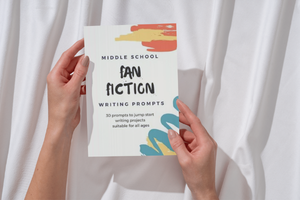
Want something ready to use for your student? I've put together a book with 30 FanFiction writing prompts for use with middle or high school students (or anyone wanting a starting point for a writing project). Each 2 page spread includes a prompt lined paper for writing. Extra lined pages are included in the back for any stories that run on a little longer. Available on Amazon
FanFiction writing may just open your student up to a larger writing community. Just like with any online community, not everything is suitable for everyone. Click here for some ideas and cautions about sharing FanFiction stories.
Use one of my prompts or your own? We'd love to read it. Feel free to post it in the comments below!
** An Important Note – Fanfiction is extremely popular. If it’s a book, movie, TV show, celebrity, or anything else in pop culture – there’s probably a fanfiction work (fanfic) about it. Writers range from preteen to adult and the content of their writings range from G rated to Explicit. Many sites give authors the ability to give a rating to their works, but ratings are self-determined and not consistently applied. Depending on your students maturity and level of responsibility, you may want to restrict access or discuss appropriate reading and what to do if a story they’ve started isn’t what they expected.
Sharing your Work
kidfanfiction.pbworks.com – Contains material appropriate for K-6 students. Submissions and comments are emailed to the site administrator who moderates for violence, language and adult themes.
teenink.com – National magazine and website with submissions sole from teens. Has a fanfiction section as part of the overall fiction & novels section. Also accepts poetry, non-fiction and art work. Submissions may be printed in national magazine or featured on website. Allows comments on submissions. Stories, comments and forum posts are filtered for content.
fanfiction.net – Large repository of fanfics. Must be 13+ to create an account. Self rating system K (all ages) – M (Mature themes, older teens and up). Per guidelines, explicit content is not allowed. Ability to filter by content rating .
archiveofourown.org – Contains millions of works. Must be 13+ to create account. Self rating system General Audiences to Explicit. Many works are not rated and ratings are not consistently applied. Mature themes and sexual content common. Ability to filter by content rating.
Google Docs – If you want to share student stories only within a small group, Google docs could work. Enable sharing with specific files, or create a shared folder in Google Drive and all documents within the folder will be able to be viewed by authorized users.
More options for sharing with the world at large include publishing your own website on WordPress.com, creating a Tumblr.com account, or sharing on wattpad.com. Each has it’s own benefits and drawbacks.
My kids are HUGE fans of Wild Kratts. I’m pretty sure they have seen every episode, most more than once. When I heard there would be four new episodes all about reptiles this week it seemed perfect for a reptile unit study. I had to work Monday and a bit on Tuesday, a public speaking assignment to prepare and present on Thursday, and a gluten free lasagna to cook and deliver for a volunteer lunch on Friday. It was a bit of a busy week but we managed to get a good deal of fun and learning done.
Monday – Work day for me. No school / free reading.
Draw a rattlesnake using a shape pattern on the skin
Library to pick up books
Wednesday
**”What is a reptile?” – non fiction reading & comprehension passage – updated KWL sheets
Snake trail addition and subtraction math game – Mark alternating spaces with + and – signs, shuffle a stack of playing cards with face cards removed. Each child receives a die, dry erase board and marker, and game marker. Student rolls the die and moves the appropriate number of spaces. They draw 2 cards from the pile and write the problem & solution on their board using the operation they landed on. Continue until board is full. Fast finishers can go back and reverse the operation for extra practice. – Note: The original printable from Scholastic is no longer available. A slightly blurry version is available at the link.
Wild Kratts episode “Gila Monster Under My House”
Spike the Mixed Up Monster by Susan Hood (fiction book – Spanish vocab)
Friday **”Alligator” and “Crocodile” – non fiction reading & comprehension passages
**Alligator and Crocodile Venn diagram (compare contrast)
Wild Kratts episode “Mom of a Croc”
Reptile exhibit at Knoxville Zoo
Zoo journals – sketches of snakes at zoo & writing prompt “If I worked at the zoo…”

 If you’ve been in the homeschooling world for more than five minutes, you’ve probably heard the phrase “unit studies” thrown around. But if the thought of building an entire custom curriculum from scratch feels overwhelming, or if you are stuck in a rigid textbook rut that is draining the joy out of your school days, I have some exciting news for you.