If you’ve been in the homeschooling world for more than five minutes, you’ve probably heard the phrase “unit studies” thrown around. But if the thought of building an entire custom curriculum from scratch feels overwhelming, or if you are stuck in a rigid textbook rut that is draining the joy out of your school days, I have some exciting news for you.
Today, we are breaking down exactly why unit studies are so powerful, how you can easily design your own, and some brand-new tools (both physical and free printables!) to help you do it.
1. The Magic of Unit Study Learning (Even as a Supplement!)
A unit study takes a single, fascinating topic and weaves multiple subjects like history, science, language arts, and art naturally around it.
The biggest benefit? Deep engagement. When children get to dive headfirst into a topic they actually care about, learning stops feeling like a chore. They aren’t just memorizing disjointed facts for a Friday test; they are making meaningful connections across subjects.
Pro-Tip: You don’t have to completely abandon your current curriculum to enjoy this! Unit studies make the perfect supplement. You can take a week-long break between textbook chapters to do a deep dive into a seasonal topic, or use a mini-unit study on Friday afternoons to add a splash of hands-on excitement to your routine.
2. How to Build Your Study: From Brainstorming to Reflection
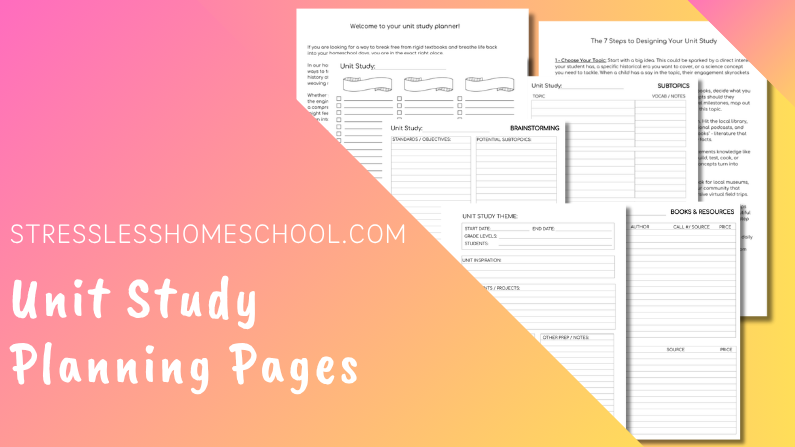
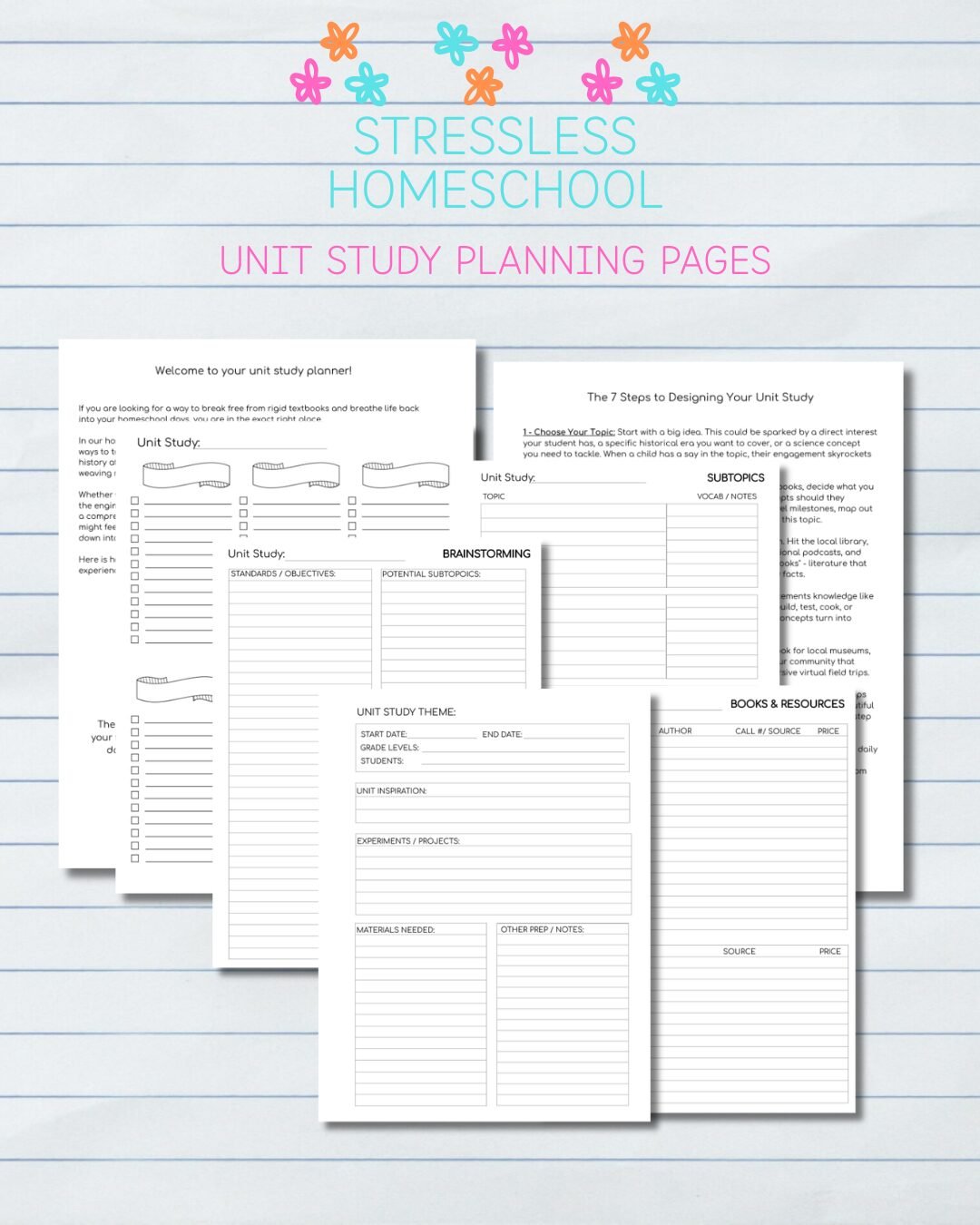
To make planning stress-free, I break the process down into a simple, structured workflow using a dedicated 8-page system. Here is a quick look at how to easily build your next unit:
Brainstorm & Target: Start by dumping all your big ideas onto paper. Once you have a theme, decide on your core learning objectives. What do you actually want your student to walk away with?
Source & Align: Gather library books, documentaries, podcasts, and games. If a book doesn’t serve a goal, save it for free reading! This keeps your study lean and purposeful.
Hands-on & Field Trips: Map out your tactile experiments, cooking projects, and local field trips. This is where abstract concepts turn into real-world understanding.
Daily Flow & Reflection: Lay your resources out into a flexible daily schedule. At the end of the unit, use the Review & Reflection page to log completed books, track achievements, and let your child note what they loved most.
3. Prefer a Bound Book? Find it on Amazon!
If you love the feeling of a physical notebook in your hands, I am thrilled to share that The Homeschool Unit Study Planner is officially published and available on Amazon!
This physical edition is perfect for parents who want a beautiful, durable archive of their school year. It features all of our brainstorming tools, the full how-to guide, and enough duplicated 8-page bundles to plan, track, and record 15 complete unit studies. When the year is over, it doubles as an official portfolio and a gorgeous keepsake of everything your family accomplished.
4. Print-Your-Own for Free (or Donation) via Ko-Fi!
I know that every homeschool budget looks different, and I want these tools to be accessible to absolutely everyone. If you prefer a loose-leaf system, want to plug pages into a 3-ring binder, or just want to try a single unit before committing to a full book, I’ve got you covered.
I have made a digital, printable version of the entire planning template pack available on my Ko-Fi page.
You can download it for free (just enter $0 at checkout), or choose to leave a small donation if you find the resource helpful. Your generous support helps me keep creating free tools, guides, and resources for our amazing community!
Students draw or write about how they have changed since 2020, what their life is like now, and what they expect for to happen by 2024. Simple worksheet that can be adapted to various ages, skills, etc.
What advice would you give to yourself four years ago? What do you hope your life is like four years from now? Write a letter to your past or future self.
Eight common idioms that use the word “leap” in a figurative way. Space for students to write what the idiom means and draw or write what the literal phrase sounds like.
I love the idea of planning everything out and being the most organized homeschool mom anyone has ever seen. In theory.
Real life… Not so much. We’re definitely more of a go-with-the-flow, have-a-goal-but-flexible-on-getting-there kind of family. While my now 12 year old thrives on structure, any deviation from “the plan” can result in an anxiety spiral. We’re working on it.
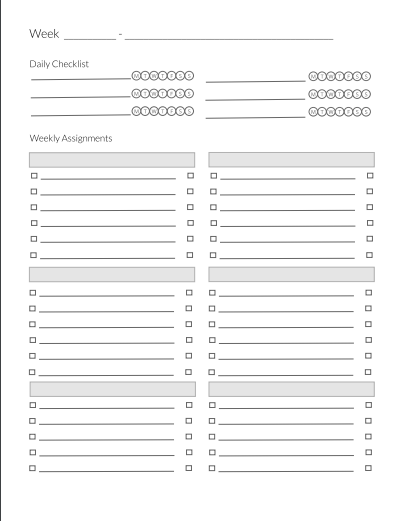
Meanwhile, what works fairly well for us is to have a general plan (cover x number of pages in x subject most weeks) and outline each week or two as we go. Since I couldn’t find a planning book or pages that fit our needs, I did what I usually do. I made my own.
These pages are extremely flexible. Some weeks I’ll want to plan lessons for specific days to fit a unit study or special activities. Those weeks I’ll use the sections to assign lessons for each day. Other weeks I don’t care if he works on one subject all day or in whatever order he chooses – as long as the week’s work gets done – so can list lessons by subject.
The checkmarks to the left of each lesson we use as “done” to quickly see the week’s progres. The right side checkmarks can be used to show which assignments I’ve checked over or to indicate that he needs help with an assignment.
The second page has plenty of room to list all the “extras” as they happen. Books read, videos watched, field trips, library visits, special projects, etc.
You can download these pages for free below – or – purchase on Amazon a 128 page softcover book that includes
yearly attendance calendar
2 year (July 2018 – June 2020) calendar pages with space to note important dates
12 year overview planning spaces for yearly overview planning
52 weeks of undated planning & record keeping pages
extra lined and dot grid pages for book lists, co-op schedules, unit study planning, notes, diagrams, or whatever you need
Free Planning Pages
Free weekly home school planning and record keeping pages
We used Disney’s Imagineering DVDs from our library to get ready for our trip. The 11-video series covers a ton of information in a fun, interactive way. It was funny listening to the kids as we went through the park, “Remember when Asa (the DVD host) did that?”
The series includes:
Energy
Fluids
Newton’s 3 Laws of Motion
Gravity
Friction
Magnetism
Electricity
Levers & Pulleys
Trajectory
Design & Models
Animal Adaptations: Communication
Each DVD includes instructions for a try-it-yourself, interactive activity to reinforce the science principles in the video!
I highly recommend incorporating this series into your pre-trip homeschooling! A science teacher has archived 5 of the videos on her YouTube channel (as of June 2026).
I found the entire series available at my local library. Some of the DVDs are also available on Amazon or Ebay.
Sometimes things just converge together and make planning a extras for the week nearly impossible. For me, that’s usually the same week I need the kids occupied so I can concentrate on other work deadlines. Last week was one of those weeks. While searching for something else I came across the Pack-N-Go Girls Mystery series and the related “extending the learning” packs on TeachersPayTeachers.com. With limited time and no plan in place I bought the Kindle version of the first Mexico book – Mystery of the Thief in the Night (Pack-n-Go Girls – Mexico Book 1) – and downloaded the free packs from TPT. I also added in some ancient civilizations videos & worksheets from BrainPop.com (Maya, Aztec, Inca, Columbian Exchange, Conquistadors) and our regular math and ELA / spelling schedule.
I don’t think this week’s lesson will win and awards but it was exactly what we needed to get a little something extra during the week and not fall behind. With additional books set in Mexico, Austria and Thailand and more free related learning packs on TPT if I ever need another no-prep week I’m glad to know they are there.
My kids are HUGE fans of Wild Kratts. I’m pretty sure they have seen every episode, most more than once. When I heard there would be four new episodes all about reptiles this week it seemed perfect for a reptile unit study. I had to work Monday and a bit on Tuesday, a public speaking assignment to prepare and present on Thursday, and a gluten free lasagna to cook and deliver for a volunteer lunch on Friday. It was a bit of a busy week but we managed to get a good deal of fun and learning done.
Monday – Work day for me. No school / free reading.
Draw a rattlesnake using a shape pattern on the skin
Library to pick up books
Wednesday
**”What is a reptile?” – non fiction reading & comprehension passage – updated KWL sheets
Snake trail addition and subtraction math game – Mark alternating spaces with + and – signs, shuffle a stack of playing cards with face cards removed. Each child receives a die, dry erase board and marker, and game marker. Student rolls the die and moves the appropriate number of spaces. They draw 2 cards from the pile and write the problem & solution on their board using the operation they landed on. Continue until board is full. Fast finishers can go back and reverse the operation for extra practice. – Note: The original printable from Scholastic is no longer available. A slightly blurry version is available at the link.
Wild Kratts episode “Gila Monster Under My House”
Spike the Mixed Up Monster by Susan Hood (fiction book – Spanish vocab)
Friday **”Alligator” and “Crocodile” – non fiction reading & comprehension passages
**Alligator and Crocodile Venn diagram (compare contrast)
Wild Kratts episode “Mom of a Croc”
Reptile exhibit at Knoxville Zoo
Zoo journals – sketches of snakes at zoo & writing prompt “If I worked at the zoo…”
 If you’ve been in the homeschooling world for more than five minutes, you’ve probably heard the phrase “unit studies” thrown around. But if the thought of building an entire custom curriculum from scratch feels overwhelming, or if you are stuck in a rigid textbook rut that is draining the joy out of your school days, I have some exciting news for you.





 – and downloaded the


