Students draw or write about how they have changed since 2020, what their life is like now, and what they expect for to happen by 2024. Simple worksheet that can be adapted to various ages, skills, etc.
What advice would you give to yourself four years ago? What do you hope your life is like four years from now? Write a letter to your past or future self.
Eight common idioms that use the word “leap” in a figurative way. Space for students to write what the idiom means and draw or write what the literal phrase sounds like.
Writing fiction is hard. It's hard for people who love to write, want to write, and have something they want to write about. I have enough half-formed stories in my head and belong to enough writers' support groups to know this.
If it's hard for an adult when they have all that going for them, imagine how much more difficult it is for a student being told, "Be creative. Write a story." Coming up with a plot and characters can overwhelm even creative kids, creating a negative feedback loop. "I'm not good at writing. I can't write. I hate writing." Story prompts are a huge help. But plenty of young writers still struggle with developing characters and writing realistic dialogue.
I wanted to focus on fiction writing this year and decided to experiment introducing FanFiction (basically "borrowing" characters from another book, movie, TV series or other work) to make the writing more interesting. From the very start my somewhat-reluctant-to-write 7th grader was excited about the idea. Our first step was to brainstorm of all the books (especially series), movies and TV shows that he was particularly familiar with. That way, as he was given each prompt and assignment, there was a cast of characters just waiting to be written about.
Our first prompt - "Write a scene of dialogue between at least two characters. One person can only say 'I don't want to.'" - was just silly enough to get the ball rolling and have fun with the writing process. The next prompt, "write a survival story", was intended to be a short assignment to go along with our Hatchet novel study. When it turned into a six page, 3,000 word story (based on characters from How to Train Your Dragon) that he wanted to work on, I knew we were on to something.
Want to try FanFiction writing with your student? Here's a few prompts to get you started:
Dialogue prompt: You think I'd notice if my best friend was a robot!
Make a list of characters and their favorite songs.
Write a scene with your characters playing a board game.
Your character is going undercover at a local school to solve a crime. Write about it.
What is your character's morning routine?
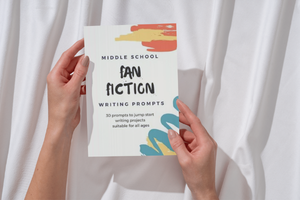
Want something ready to use for your student? I've put together a book with 30 FanFiction writing prompts for use with middle or high school students (or anyone wanting a starting point for a writing project). Each 2 page spread includes a prompt lined paper for writing. Extra lined pages are included in the back for any stories that run on a little longer. Available on Amazon
FanFiction writing may just open your student up to a larger writing community. Just like with any online community, not everything is suitable for everyone. Click here for some ideas and cautions about sharing FanFiction stories.
Use one of my prompts or your own? We'd love to read it. Feel free to post it in the comments below!
** An Important Note – Fanfiction is extremely popular. If it’s a book, movie, TV show, celebrity, or anything else in pop culture – there’s probably a fanfiction work (fanfic) about it. Writers range from preteen to adult and the content of their writings range from G rated to Explicit. Many sites give authors the ability to give a rating to their works, but ratings are self-determined and not consistently applied. Depending on your students maturity and level of responsibility, you may want to restrict access or discuss appropriate reading and what to do if a story they’ve started isn’t what they expected.
Sharing your Work
kidfanfiction.pbworks.com – Contains material appropriate for K-6 students. Submissions and comments are emailed to the site administrator who moderates for violence, language and adult themes.
teenink.com – National magazine and website with submissions sole from teens. Has a fanfiction section as part of the overall fiction & novels section. Also accepts poetry, non-fiction and art work. Submissions may be printed in national magazine or featured on website. Allows comments on submissions. Stories, comments and forum posts are filtered for content.
fanfiction.net – Large repository of fanfics. Must be 13+ to create an account. Self rating system K (all ages) – M (Mature themes, older teens and up). Per guidelines, explicit content is not allowed. Ability to filter by content rating .
archiveofourown.org – Contains millions of works. Must be 13+ to create account. Self rating system General Audiences to Explicit. Many works are not rated and ratings are not consistently applied. Mature themes and sexual content common. Ability to filter by content rating.
Google Docs – If you want to share student stories only within a small group, Google docs could work. Enable sharing with specific files, or create a shared folder in Google Drive and all documents within the folder will be able to be viewed by authorized users.
More options for sharing with the world at large include publishing your own website on WordPress.com, creating a Tumblr.com account, or sharing on wattpad.com. Each has it’s own benefits and drawbacks.