If you’ve been in the homeschooling world for more than five minutes, you’ve probably heard the phrase “unit studies” thrown around. But if the thought of building an entire custom curriculum from scratch feels overwhelming, or if you are stuck in a rigid textbook rut that is draining the joy out of your school days, I have some exciting news for you.
Today, we are breaking down exactly why unit studies are so powerful, how you can easily design your own, and some brand-new tools (both physical and free printables!) to help you do it.
1. The Magic of Unit Study Learning (Even as a Supplement!)
A unit study takes a single, fascinating topic and weaves multiple subjects like history, science, language arts, and art naturally around it.
The biggest benefit? Deep engagement. When children get to dive headfirst into a topic they actually care about, learning stops feeling like a chore. They aren’t just memorizing disjointed facts for a Friday test; they are making meaningful connections across subjects.
Pro-Tip: You don’t have to completely abandon your current curriculum to enjoy this! Unit studies make the perfect supplement. You can take a week-long break between textbook chapters to do a deep dive into a seasonal topic, or use a mini-unit study on Friday afternoons to add a splash of hands-on excitement to your routine.
2. How to Build Your Study: From Brainstorming to Reflection
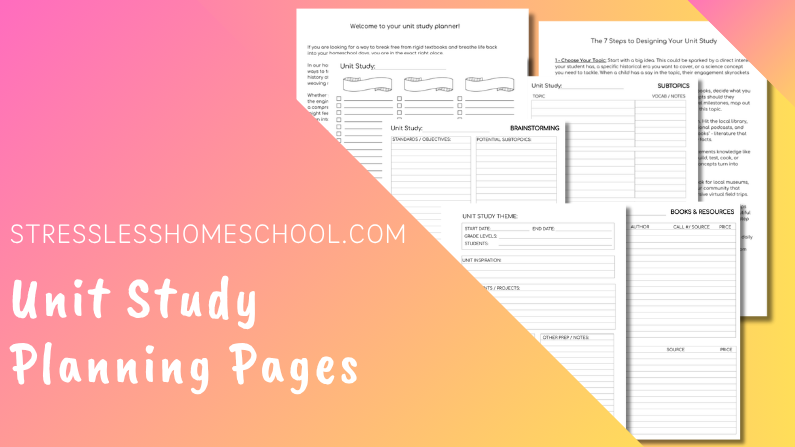
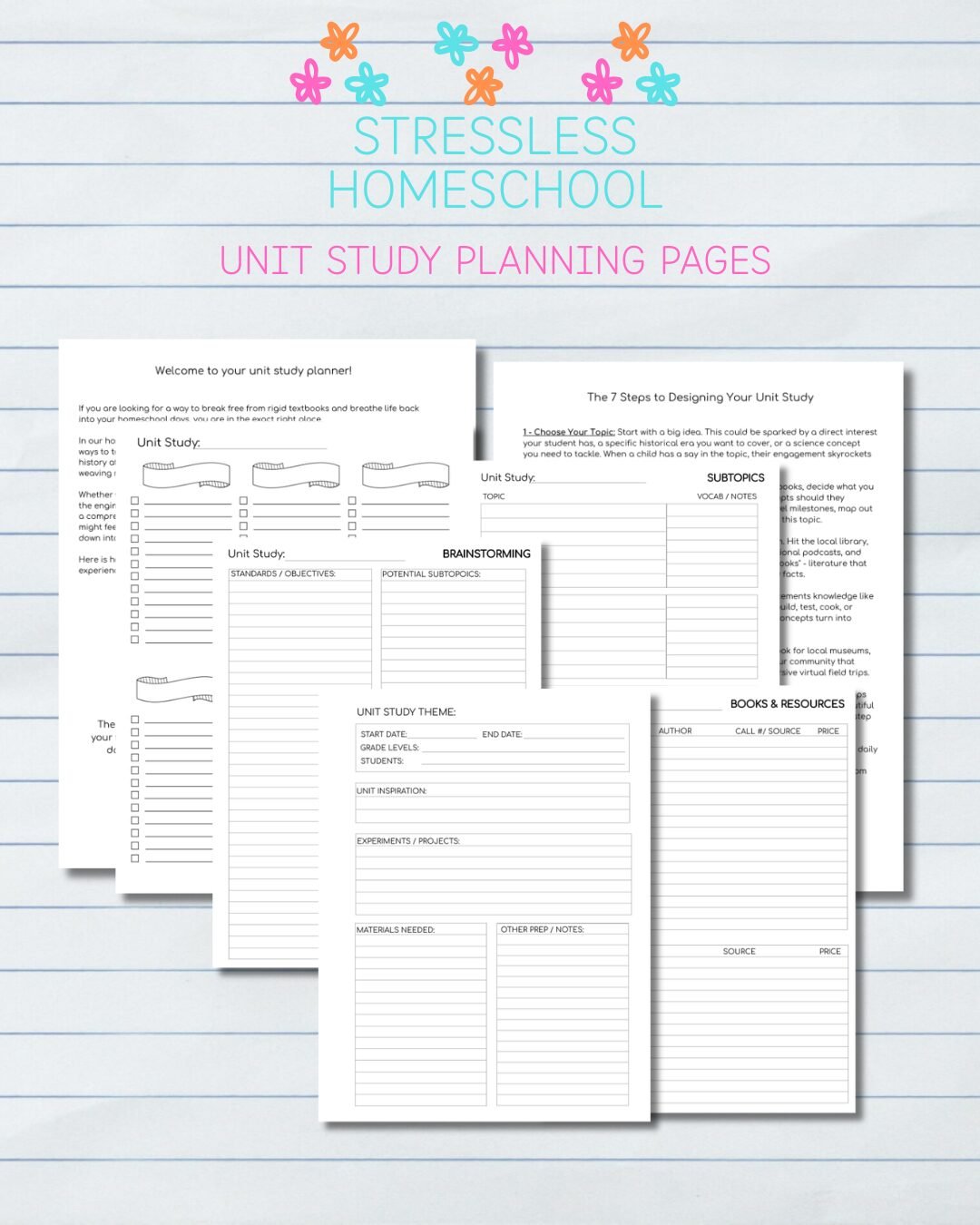
To make planning stress-free, I break the process down into a simple, structured workflow using a dedicated 8-page system. Here is a quick look at how to easily build your next unit:
Brainstorm & Target: Start by dumping all your big ideas onto paper. Once you have a theme, decide on your core learning objectives. What do you actually want your student to walk away with?
Source & Align: Gather library books, documentaries, podcasts, and games. If a book doesn’t serve a goal, save it for free reading! This keeps your study lean and purposeful.
Hands-on & Field Trips: Map out your tactile experiments, cooking projects, and local field trips. This is where abstract concepts turn into real-world understanding.
Daily Flow & Reflection: Lay your resources out into a flexible daily schedule. At the end of the unit, use the Review & Reflection page to log completed books, track achievements, and let your child note what they loved most.
3. Prefer a Bound Book? Find it on Amazon!
If you love the feeling of a physical notebook in your hands, I am thrilled to share that The Homeschool Unit Study Planner is officially published and available on Amazon!
This physical edition is perfect for parents who want a beautiful, durable archive of their school year. It features all of our brainstorming tools, the full how-to guide, and enough duplicated 8-page bundles to plan, track, and record 15 complete unit studies. When the year is over, it doubles as an official portfolio and a gorgeous keepsake of everything your family accomplished.
4. Print-Your-Own for Free (or Donation) via Ko-Fi!
I know that every homeschool budget looks different, and I want these tools to be accessible to absolutely everyone. If you prefer a loose-leaf system, want to plug pages into a 3-ring binder, or just want to try a single unit before committing to a full book, I’ve got you covered.
I have made a digital, printable version of the entire planning template pack available on my Ko-Fi page.
You can download it for free (just enter $0 at checkout), or choose to leave a small donation if you find the resource helpful. Your generous support helps me keep creating free tools, guides, and resources for our amazing community!
Hard to believe we’ve reached the last year of middle school! Even though we’ve incorporated some high school level work last year, this year seems like a huge milestone.
We’re also starting the school year in a bit of flux. I’ve been the primary caregiver for my grandparents for the past three and a half years. Since both of them have now passed away, it’s time for me to get back in the the working world. That means restarting my small business consultancy – now in a city I’ve been living in for almost four years but where I don’t have many business contacts. We also need to find an affordable, safe place to live and move in the next few weeks. Anybody surprised that I’m a little behind on planning for the school year?
I’ve been researching open-source and online curriculum for a while. Not being tied to one curriculum works well for us and having everything online is especially helpful this year since I have no desire to move a year’s worth of books almost as soon as we get them. Fortunately, I have a student who is very much a self-starter when it comes to getting his school work done. Our homeschool planner does double-duty, outlining the “plan” for each week and recording anything extra that gets done.
My 8th plan isn’t fancy, but it should get us started and on track through the move at least. We can always add to or adjust as we go. Here’s the resources I’ve pulled together for our year so far… (more…)
For us, especially in the pre-school and elementary ages, homeschooling looked a lot like kids just go everywhere mom goes. These little sponges pick up so much, incorporating lessons and practice into everyday tasks. We even created a catchphrase, singing “Everyday Math!”, any time we had to figure some real life math problem.
Bringing kids along everywhere has some challenges though. The number one difficulty for us – waiting. Whether standing in line or long rides in the car, bored kids quickly turn into grumpy kids. Our solution was playing games whenever the need arose. Looking back, quite a few of our silly games laid important foundations in math, language and thinking ability.
#1 – The Alliteration Game
Take turns adding words to a sentence, each beginning with the same letter or sound. Sentences don’t have to be true but should be grammatically correct. Words can be added at any point in the sentence. Small words (articles, prepositions) don’t have to be alliterative. Example:
Keep going until you’re out of words to add. (Our record is 35 words!) If kids get stuck, prompt with questions. What adjective could you use to describe the gorillas? How did they grab them? Is there an adverb for that? For younger kids its great for building phonemic awareness. Older kids get to practice and learn new vocabulary and reinforce parts of speech.
#2 – Higher or Lower
The classic number guessing game. One player chooses a number and the other(s) close in, being told higher or lower after each guess. Easily adapts for younger kids (1-10) or older (1-1,000,000). Develops number sense, reasoning ability and mental math calculations.
#3 – Share a story
Take turns telling a story. Start out by asking the kid(s) for a character and setting, the crazier the better. Then each person takes a turn, adding 2-4 sentences to move the story along. After the story is over, older kids can be asked to identify the plot, conflict, or resolution to add to the educational aspects.
#4 – Word Association
This one has only gotten more fun as my son has gotten older (and built a bigger vocabulary). Start with any compound word. Take part of the word and use in a new compound word or phrase. Continue, building the bigger chain you can without repeating. Or make the goal to get back to original word. Example:
Race horse
Foot race
Clubfoot
Poker club
Poker chip
Chips and dip
Dipstick
Stick in the mud
Mud pie
Apple pie
Candy apple…
#5 – 20 Questions type games
I Spy… I’m thinking of a food, an animal, etc… Classic 20 questions. These types of games – where the chooser can only answer yes or no to the questioner – develop logical thinking and questioning skills and can be played with any child old enough to speak.
Do you have any games to add to the list? Share them below!
So what’s up with the long hiatus from new posts? In short, Caregiving for elderly grandparents while maintaining even VERY part-time work from home and homeschooling is exhausting mentally, physically and emotionally. Leaving very little creative juice for creating amazing unit studies that challenge a now middle schooler and are worth posting about.
To take some of the load off we used online curriculum for the past two years – DiscoveryK12 (5th grade) and MobyMax.com (6th grade). Neither program was perfect but it didn’t require a lot of hand-on administration from me which made it ideal for our circumstances. Again, not much post worthy there. Academic progress was made, state requirements were fulfilled, and we made it through a couple of very hard years.
So here we are, entering 7th grade, mourning the loss of one grandparent while the other – who doesn’t require constant care – is still in need of daily assistance. We’re returning to more of a hands-on, offline schooling, primarily at my son’s request. More structured and with more textbook than our early grades but with more room for creativity and combining subjects into unit studies than online schooling allowed.
In some ways, the past couple years may have set us back a little academically. By third/fourth grade we were doing work that was in many ways beyond the “typical” grade level work. If we had continued on a more interest-led, deepening study of those subjects we might be even farther now than we are. But the past two and half years have given us so much more than book smarts. The opportunity for my son to really know his great-grandparents and have a close relationship with them is priceless. And the growth in the sense of personal responsibility and competency in so many real life situations is much more valuable. This perspective, as much as anything, keeping me from the endless “Am I doing enough?” questions that would make our homeschooling journey anything but stressless.
Going forward I hope to be able to blog about some interesting and share-worthy projects and lessons. We have some ambitious plans going forward and I’m exciting to be creating some resources for our own use that I think others may benefit from as well. My home school planner is already making my life easier. So stay tuned and if I disappear again for a while it’s probably just to deal with life as it comes.
I love the idea of planning everything out and being the most organized homeschool mom anyone has ever seen. In theory.
Real life… Not so much. We’re definitely more of a go-with-the-flow, have-a-goal-but-flexible-on-getting-there kind of family. While my now 12 year old thrives on structure, any deviation from “the plan” can result in an anxiety spiral. We’re working on it.
Meanwhile, what works fairly well for us is to have a general plan (cover x number of pages in x subject most weeks) and outline each week or two as we go. Since I couldn’t find a planning book or pages that fit our needs, I did what I usually do. I made my own.
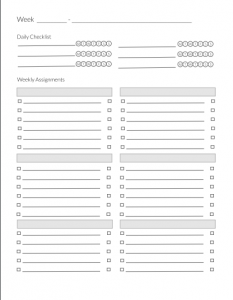
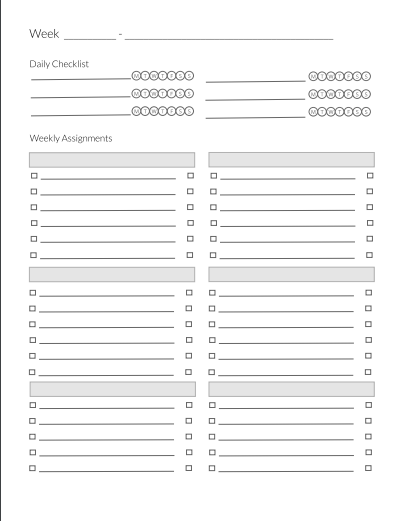
These pages are extremely flexible. Some weeks I’ll want to plan lessons for specific days to fit a unit study or special activities. Those weeks I’ll use the sections to assign lessons for each day. Other weeks I don’t care if he works on one subject all day or in whatever order he chooses – as long as the week’s work gets done – so can list lessons by subject.
The checkmarks to the left of each lesson we use as “done” to quickly see the week’s progres. The right side checkmarks can be used to show which assignments I’ve checked over or to indicate that he needs help with an assignment.
The second page has plenty of room to list all the “extras” as they happen. Books read, videos watched, field trips, library visits, special projects, etc.
You can download these pages for free below – or – purchase on Amazon a 128 page softcover book that includes
yearly attendance calendar
2 year (July 2018 – June 2020) calendar pages with space to note important dates
12 year overview planning spaces for yearly overview planning
52 weeks of undated planning & record keeping pages
extra lined and dot grid pages for book lists, co-op schedules, unit study planning, notes, diagrams, or whatever you need
Free Planning Pages
Free weekly home school planning and record keeping pages
Social Studies is one area where we tend to study what comes up instead of following a set curriculum. Today’s lesson on Lewis and Clark was one of those random lessons that turned out pretty well.
We started by watching a Netflix documentary (National Geographic: Lewis & Clark , Great Journey West), pausing to follow the expedition’s journey on our US map and discussing how this journey relates to what they already knew.
After watching the movie the kids created postcards (various templates available at Teachers Pay Teachers) as if they were on the expedition writing to someone back home.
 If you’ve been in the homeschooling world for more than five minutes, you’ve probably heard the phrase “unit studies” thrown around. But if the thought of building an entire custom curriculum from scratch feels overwhelming, or if you are stuck in a rigid textbook rut that is draining the joy out of your school days, I have some exciting news for you.